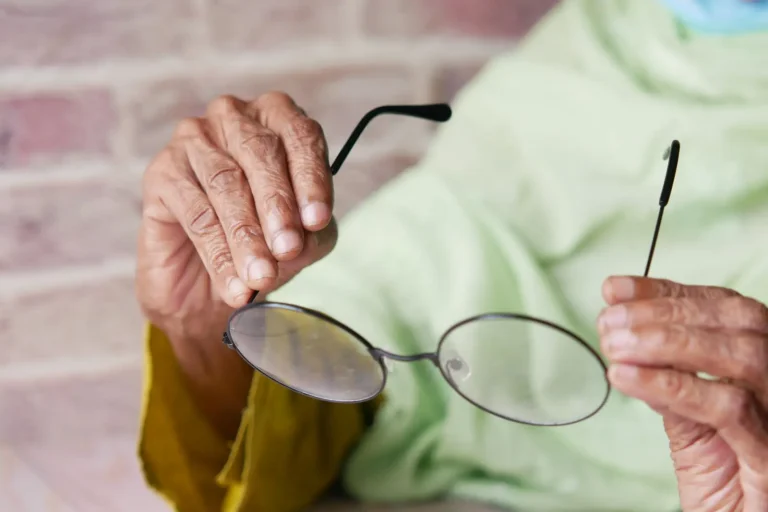


The way lenses bend light at the edges has changed considerably over the past fifteen years, though most people wearing glasses never consciously notice it. I’ve fit thousands of pairs, and the difference between an older lens design and a current one shows up most clearly when someone moves their eyes to the side or looks down at an angle. The peripheral field – that zone beyond your direct line of sight – has become noticeably wider and clearer in modern designs, and it’s not accidental.
For decades, the standard approach to lens design was relatively straightforward: optimize the center for sharpness, accept that the edges would be softer, and call it acceptable. Peripheral distortion was treated as an inevitable trade-off. You’d notice it when you glanced sideways or tried to read something slightly off to the side. The image would swim a little, colors would shift, or straight lines would bow outward. Most people adapted to it without realizing they were compensating.
Modern lens designs work differently. They use computational modeling to map how light behaves across the entire surface of the lens, not just the center. This allows manufacturers to spread optical correction more evenly across a wider area. The result is that your usable peripheral vision – the zone where you can actually see clearly without moving your head – has expanded significantly.
The geometry shift: wider useful zones
The key change is in how the lens surface is shaped. Older designs used relatively simple curves, often the same curvature front and back. Modern lenses employ what’s called “freeform” or “digital” surfacing, where the front and back surfaces are calculated point-by-point to correct vision errors across a much broader field. This isn’t a minor tweak. The difference in how much of your visual field is actually sharp is substantial.
When you’re wearing a well-designed modern lens and you shift your gaze to the side, the image stays clearer longer before degrading. You can read a dashboard gauge or glance at a phone notification without the fuzzy, distorted sensation that older lenses produced. The transition from sharp to blurry is gentler and happens further into the periphery. For people who spend time driving or working at variable distances, this matters more than it might initially seem.
The peripheral zone also shows less color fringing – that purple or green shimmer you’d sometimes see at the edges of objects when looking through older glasses. This happens because modern designs correct for chromatic aberration (the way different wavelengths of light refract slightly differently) across a wider area. It’s a technical detail, but it translates into a visual experience that feels more natural and less fatiguing.
Aspheric and atoric corrections
Most modern prescription lenses now incorporate aspheric elements, meaning the surface isn’t a simple sphere but a more complex curve that flattens toward the edges. This geometry allows light rays hitting the outer portions of the lens to converge more naturally, reducing the aberrations that plagued older designs. For people with higher prescriptions, this is particularly noticeable. Someone with a strong correction who switches to an aspheric lens often reports that the world looks less “pincushioned” or “barrel-distorted” than it did before.
Atoric designs take this further by correcting for astigmatism across the entire lens surface rather than just in the center. This means the peripheral vision improvement applies even to people whose prescription includes a cylinder value. In the past, astigmatic prescriptions often resulted in even more peripheral distortion than simple myopia or hyperopia. Now, the correction is more consistent across the field.
What this means for everyday use
In practical terms, peripheral vision improvements show up in specific situations. When you’re driving, you notice it in how much of the road you can see clearly without moving your head. When you’re working at a computer, you can glance at something in your peripheral vision and it resolves faster. If you play sports or do activities requiring quick peripheral awareness, the sharper edges make a real difference in reaction time and spatial awareness.
There’s also a subtle but real effect on eye strain. When your peripheral vision is blurry or distorted, your eyes and brain work harder to compensate. You make more micro-movements, you tense up slightly, and over hours that accumulation matters. Clearer peripheral zones mean less compensatory effort, which translates into less fatigue by the end of the day.
The improvement isn’t infinite, though. Peripheral vision will always be less sharp than central vision – that’s just how human eyes work. But the zone where vision is “good enough” to use without conscious effort has expanded. Most people in a modern lens can use roughly 30 to 40 degrees off-axis comfortably, whereas older designs often made that zone significantly smaller.
Individual variation and fitting
Not all modern lenses perform equally. The quality of the peripheral improvement depends on the specific design, the manufacturer’s computational approach, and how the lens is fitted to your face. A lens that’s poorly centered or positioned at the wrong angle can lose much of its peripheral benefit. This is why fitting matters more than it used to. A good optician or dispenser will check that your lenses are positioned correctly relative to your eyes, because even a small deviation can compromise the peripheral performance.
Prescription strength also influences how much improvement you’ll perceive. Someone with a mild prescription might notice the difference as subtle; someone with a strong correction often notices it immediately. The higher the prescription, the more the older designs struggled with peripheral aberrations, so the improvement is more dramatic.
Material choices also play a role. High-index materials allow for flatter, thinner lens designs, which can actually improve peripheral optics because the light paths are less extreme. Coating technology has improved too – anti-reflective coatings are now more sophisticated, and they reduce the internal reflections that could degrade peripheral image quality.
What I’ve observed over years of fitting is that people often don’t realize how much their peripheral vision was compromised until they switch to a modern design. Then, when they go back to an older pair for comparison, the difference becomes obvious. The world looks slightly dimmer, softer at the edges, and requires more head movement to see things clearly. It’s one of those improvements that’s most noticeable in retrospect.